






BF-ESSE: FDA-Registered European Supplement Manufacturer for U.S. Projects
For BF-ESSE, one of the first formal steps in developing a manufacturing route for U.S. customers has now been completed: the company’s manufacturing facility in Riga, Latvia is registered with the U.S. Food and Drug Administration as a foreign food facility.
For supplement brands looking for a European manufacturing partner, this is an important starting point. But understanding what FDA registration means — and what it does not mean — is just as important as the registration itself.
Why FDA Food Facility Registration matters

Foreign facilities that manufacture, process, pack or hold food intended for consumption in the United States may be required to register with FDA.
Dietary supplements fall within the U.S. food regulatory framework, which means facility registration becomes one of the first questions when a foreign contract manufacturer plans to supply the American market.
For a U.S. brand evaluating a manufacturer in Europe, registration establishes that the manufacturing facility is present in FDA's food facility registration system for the activities and product categories declared in its record.
It also means that the foreign facility has designated a U.S. agent for communications with FDA.
This removes one basic uncertainty at the beginning of a project. Instead of asking whether the European manufacturing site is registered at all, the conversation can move toward the product itself.
And that is where most of the real work begins.
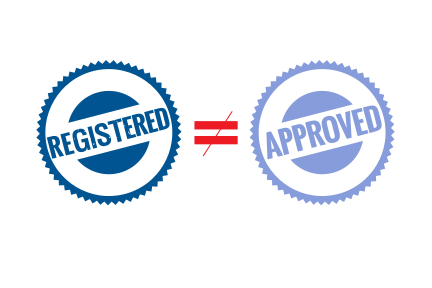
Food Facility Registration is not an FDA approval of the manufacturer. It is also not certification or endorsement by FDA.
For the same reason, a registration number should not be treated as evidence that every manufacturing operation automatically complies with the dietary supplement current good manufacturing practice requirements in 21 CFR Part 111.
Those are separate requirements.
the Riga manufacturing facility is registered with FDA as a foreign food facility.
The regulatory assessment of an actual U.S. product still has to be performed project by project.
Europe and the United States both have established supplement markets, but their regulatory systems are not interchangeable.
- A product sold in Europe as a food supplement may require a separate review before being manufactured as a dietary supplement for the United States.
- A capsule, powder or stick pack may be straightforward from a manufacturing perspective while still raising regulatory questions about ingredients, specifications, claims or labeling.
-
That is why BF-ESSE intends to approach U.S. manufacturing projects from the target market backward: first establish what the finished U.S. product is supposed to be, then connect the formulation, manufacturing process, testing, packaging and documentation to that product.
At its Riga manufacturing facility, the company works with several dosage and packaging formats, including capsule filling, powder blending, stick packs and sachets, blister packaging and bottling.
Before production, the project still has to connect the raw-material specifications, formulation, manufacturing controls, testing strategy, packaging and finished-product requirements.
That makes U.S. production more than an export exercise. It becomes a separate manufacturing project.
Claims also have to be considered separately.
Wording that has been used successfully on an EU food supplement should not automatically be assumed to work in the United States.
For a contract manufacturer, this matters even when the customer remains responsible for final market-facing artwork. The product manufactured in the facility still needs to correspond with the approved formula, specifications and packaging information used during production.
Resolving these questions before printed packaging is ordered can prevent considerably more expensive corrections later.
Its practical value is different.
-
It creates the facility-level foundation from which BF-ESSE can begin evaluating relevant U.S. dietary supplement projects with customers.
A company approaching BF-ESSE with a food supplement concept can now move directly into the questions that matter for the actual product: formulation, ingredient specifications, dosage form, manufacturing feasibility, testing, packaging, U.S. labeling requirements and import responsibilities. -
The earlier these questions are addressed, the easier it becomes to determine whether a project has a realistic manufacturing route.
For brands considering supplement manufacturing in Europe for the U.S. market, that is ultimately much more useful than the words “FDA registered” alone.
FDA registration gets the facility into the system.